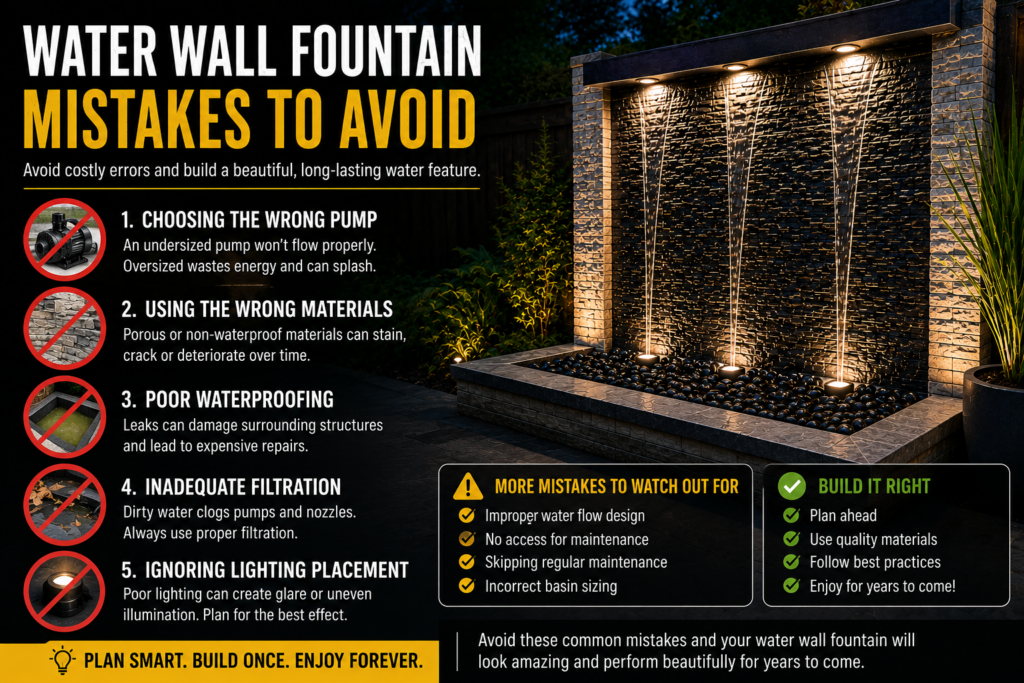
Building a water wall fountain can be one of the most rewarding DIY projects a homeowner undertakes. A well-designed water wall adds beauty, relaxation, and architectural interest to both indoor and outdoor spaces.
Unfortunately, many water wall projects fail to achieve the desired results because of a handful of common mistakes. Uneven water flow, excessive splashing, pump failures, algae growth, and maintenance headaches are often the result of poor planning rather than bad luck.
The good news is that most of these issues are completely avoidable.
In this guide, we’ll cover the most common water wall fountain mistakes and explain how to avoid them so your project looks professional, performs reliably, and provides years of enjoyment.
Mistake #1: Choosing the Wrong Pump
The pump is the heart of every water wall fountain.
One of the most common mistakes is selecting a pump based solely on price rather than performance requirements.
An undersized pump often causes:
- Weak water flow
- Dry spots
- Inconsistent water coverage
An oversized pump can cause:
- Excessive splashing
- Water loss
- Increased energy consumption
How to Avoid It
Always calculate:
- Water wall width
- Desired flow rate
- Vertical lift height
- Head pressure requirements
For most residential water walls between 24 and 48 inches wide, a pump in the 400–800 GPH range is often a good starting point.
Mistake #2: Ignoring Head Height
Many first-time builders focus only on gallons per hour (GPH) and completely ignore head height.
Head height refers to how high a pump can push water vertically.
A pump may be rated at 800 GPH but provide far less flow when pushing water several feet upward.
How to Avoid It
Choose a pump with a maximum head height at least 1.5 to 2 times the actual height of your water wall.
This helps ensure adequate flow under real-world conditions.
Mistake #3: Poor Water Distribution Design
Even if you have the perfect pump, poor water distribution can ruin the appearance of the fountain.
Common symptoms include:
- Dry streaks
- Uneven coverage
- Water channels
- Inconsistent flow patterns
How to Avoid It
Use a properly designed:
- Distribution tray
- Spillway
- Slotted PVC manifold
The goal is to distribute water evenly across the entire width of the wall.
Take time to test and adjust the distribution system before finishing the project.
Mistake #4: Building the Wall Surface Out of the Wrong Material
Not all materials perform well as water wall surfaces.
Some absorb water, stain easily, or create unpredictable flow patterns.
Materials to Avoid
- Untreated wood
- Drywall
- Highly porous stone
- Water-sensitive composites
Recommended Materials
- Slate
- Porcelain tile
- Glass
- Stainless steel
- Copper
- Stone veneer
These materials provide durability and attractive water flow.
Mistake #5: Making the Reservoir Too Small
A small reservoir may seem like a good way to save space, but it often creates ongoing maintenance problems.
Small reservoirs:
- Evaporate faster
- Require frequent refilling
- Increase pump stress
- Reduce water stability
How to Avoid It
Whenever possible, build a larger reservoir than you think you’ll need.
Additional water volume generally improves system performance and reduces maintenance requirements.
Mistake #6: Forgetting Maintenance Access
Many DIY builders focus entirely on appearance and forget that pumps eventually need cleaning and maintenance.
A beautiful water wall becomes frustrating if you must partially disassemble it every time the pump needs attention.
How to Avoid It
Design access panels or removable sections that allow easy access to:
- Pumps
- Tubing
- Electrical connections
- Reservoirs
Future maintenance will be dramatically easier.
Mistake #7: Ignoring Splash Control
Excessive splashing is one of the most common complaints among water wall owners.
Splashing can:
- Damage surrounding surfaces
- Increase water loss
- Create slipping hazards
- Increase maintenance
Common Causes
- Oversized pumps
- Rough wall surfaces
- Improper water distribution
- Incorrect basin placement
How to Avoid It
Test water flow carefully and adjust pump output until the water falls smoothly back into the reservoir.
Mistake #8: Neglecting Water Quality
Many homeowners underestimate the importance of water quality.
Poor water quality can lead to:
- Algae growth
- Mineral deposits
- Cloudy water
- Pump wear
How to Avoid It
Consider:
- Filtered water
- Distilled water
- Fountain treatments
- Regular cleaning
Good water quality improves both appearance and system longevity.
Mistake #9: Skipping Lighting
Many water walls look beautiful during the day but disappear at night.
Lighting is often overlooked during the planning phase.
Why Lighting Matters
Proper lighting:
- Highlights water movement
- Creates ambiance
- Extends enjoyment into the evening
- Adds a luxury appearance
Recommended Lighting Options
- Warm white LED strips
- Waterproof spotlights
- Integrated basin lighting
- Backlit glass panels
Lighting often delivers one of the highest visual returns for the money invested.
Mistake #10: Starting with an Overly Ambitious Project
Many first-time builders attempt a massive custom water wall as their first project.
Large projects introduce additional complexity:
- Higher costs
- More plumbing
- Larger pumps
- Greater maintenance demands
How to Avoid It
Start with a smaller project.
A simple water wall often provides valuable experience that makes larger future projects much easier and more successful.
Bonus Mistake: Ignoring Future Upgrades
Many water wall owners eventually want to add:
- Lighting
- Automation
- Better pumps
- Decorative finishes
- Landscaping
If the original design leaves no room for upgrades, future improvements become difficult.
Plan Ahead
Even if you’re building on a budget, consider future expansion during the design phase.
A little planning now can save significant time and money later.
Water Wall Fountain Success Checklist
Before beginning your project, make sure you have:
✓ Selected the correct pump
✓ Calculated head height
✓ Designed proper water distribution
✓ Chosen water-resistant materials
✓ Sized the reservoir appropriately
✓ Planned maintenance access
✓ Considered splash control
✓ Addressed water quality
✓ Included lighting
✓ Selected a realistic project size
Following this checklist dramatically increases the chances of a successful build.
Frequently Asked Questions
What is the most common water wall mistake?
Choosing the wrong pump is probably the most common issue and often leads to poor water flow or excessive splashing.
How large should a water wall reservoir be?
Larger reservoirs generally perform better and require less frequent refilling.
Are water walls difficult to maintain?
Most water walls require only modest maintenance when designed properly.
Is lighting really necessary?
No, but it significantly improves appearance and allows the water wall to be enjoyed after dark.
Final Thoughts
Most water wall fountain problems can be traced back to a few common planning mistakes. By choosing the right pump, designing proper water distribution, selecting durable materials, and planning for maintenance, you can avoid many of the frustrations that affect DIY builders.
A successful water wall doesn’t have to be expensive or complicated. Careful planning and attention to detail will often produce better results than simply spending more money.
Whether you’re building an indoor water wall, a backyard fountain, or a custom architectural feature, avoiding these common mistakes will help ensure your project looks professional and performs reliably for years to come.
Many water flow issues can be traced to poor pump selection. See Best Water Pumps for Water Wall Fountains.
Planning your first project? Read DIY Water Wall Plans.
To better understand budgeting, review our Water Wall Fountain Cost Guide.